Early orthodontics for children
Some bite problems are easier to fix while a child is still growing. Interceptive orthodontics guides the teeth and jaws early, so a small problem doesn't become a bigger one. Many children don't need it, and we'll tell you honestly if yours does.
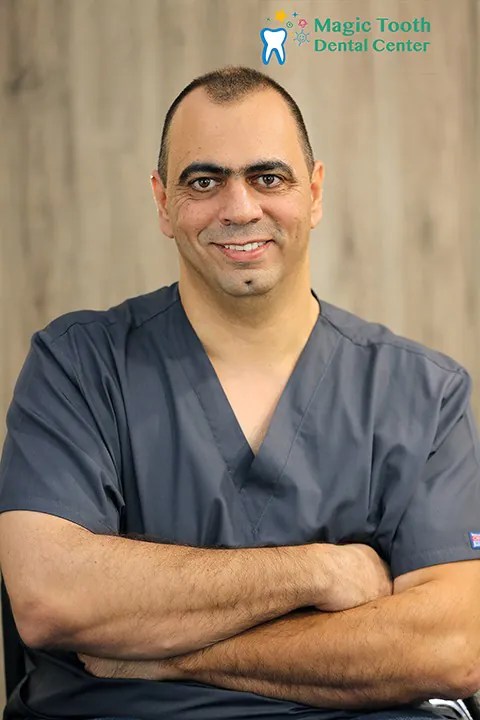 Clinical review: Dr. Farouk Rihani, consultant pediatric dentist. Reviewed November 2026.
- First check by age 7
- Uses your child's growth
- Only when it helps
What interceptive orthodontics is
Between about age 6 and 12, children have a mix of baby and adult teeth. During these years, simple appliances can widen a narrow upper jaw, correct a crossbite, make room for adult teeth or guide a tooth that is coming in the wrong place.
Early treatment helps many children, but not every bite problem needs it. Some crowding improves by itself as the adult teeth come in. We only suggest treatment when waiting would make the problem harder to fix.
Dr. Mai has a special interest in interceptive orthodontics, such as canines coming in out of place and Twin Block appliances. When a child needs full braces later, we work with Dr. Bashar Momani, consultant orthodontist at Magic Tooth Dental Center.
From check-up to treatment
A first check is often just information, not treatment.
The check
- ExamWe look at the teeth, the bite and how the jaws are growing.
- X-rayAn X-ray shows the adult teeth still under the gums, including extra or missing teeth.
The plan
- Treat now or watchWe explain whether to treat now, or to wait and check again as your child grows.
- Choosing an applianceSuch as an expander, a removable plate with springs, a Twin Block or a space maintainer.
Treatment
- FittingMost appliances are fitted without numbing.
- Regular visitsWe adjust the appliance every few weeks and check progress.
- What comes nextSome children still need braces later. Early treatment can make that treatment simpler.
Why timing mattersSome problems, like a crossbite that makes the jaw shift, are best corrected as soon as they're found.
Why act early?
Early treatment uses your child's growth to guide the teeth and jaws.
- Correcting a jaw that shifts to one side helps the jaws grow evenly.
- Upper front teeth that stick out are more likely to be injured in a fall. Early treatment may lower that risk.
- A lower jaw that bites in front of the upper one is best treated early.
- Making room early can help the adult teeth come in straighter.
Wear the appliance as advised and bring it to every visit. A removable plate only works when it's in the mouth.
Space maintainersThumb sucking and oral habitsDental anomalies
Who will see your child
We are Mai Altayeh and Farouk Rihani, consultant pediatric dentists working side by side at Magic Tooth Dental Center in Abdoun. Our work is children’s teeth, from the first tooth to the teenage years.
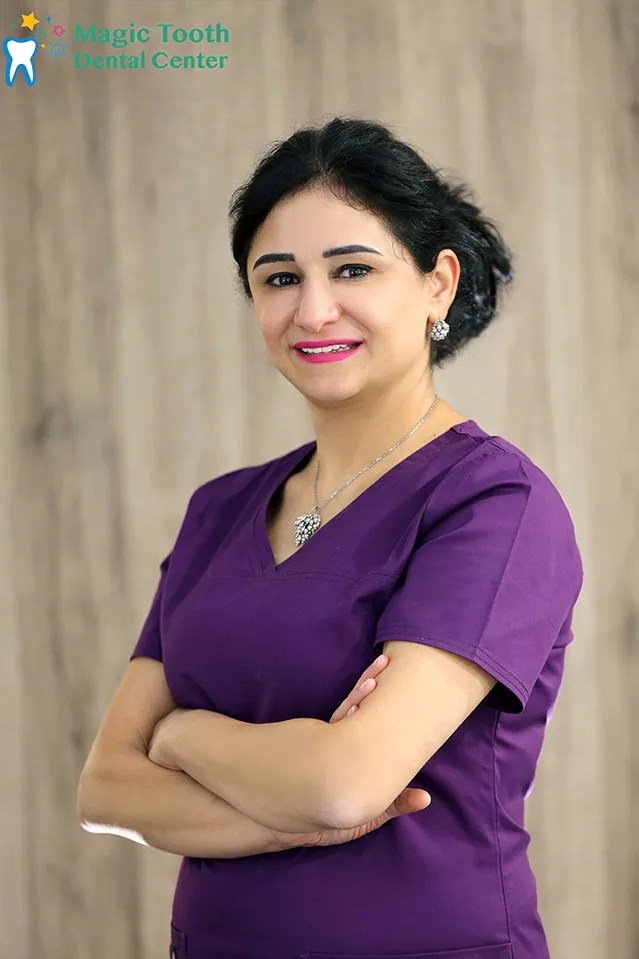
Dr. Mai Altayeh
Consultant pediatric dentist and special care dentist
MSc Pediatric Dentistry, University of Liverpool (2002). More than 20 years of practice, with laughing gas and treatment under general anesthesia.
Read profileDr. Farouk Rihani
Consultant pediatric dentist
Jordanian Board in Pediatric Dentistry (2004). More than 30 years in dentistry, with a special interest in children with special health care needs.
Read profile
Questions parents ask
At what age should my child have an orthodontic check?By age 7, or sooner if you notice a problem. Most children won't need treatment at that age.
Will my child still need braces later?Sometimes. Early treatment fixes problems that are harder to fix later, but some children still need braces once all the adult teeth are in.
Do the appliances hurt?They can feel tight for a few days after fitting or adjusting. That usually settles quickly.
How long does early treatment take?It depends on the problem. We'll give you a timeline before we start.
Can my child eat normally with an appliance?Mostly, yes. Avoid sticky sweets and chewing gum, and keep the appliance clean.
Sources
- American Academy of Pediatric Dentistry: Management of the Developing Dentition and Occlusion in Pediatric Dentistry
- American Association of Orthodontists: When Should Your Child See an Orthodontist?
- International Association of Paediatric Dentistry: Management of the Developing Dentition, Foundational Articles and Recommendations (2022)
 Opening hours
 Contact details
- Clinic+962 6 593 7076, +962 6 593 6367
- WhatsApp and mobile+962 79 660 0883 (WhatsApp), +962 79 675 2509
- Email[email protected]
- AddressBuilding 192, first floor, Princess Basma Street, Abdoun, Amman
 The map loads from Google when you tap.